Can Google Discover replace traditional SEO? The data-driven answer
Some publishers swear Discover killed classic SEO. Others think the opposite. We analyzed 47 sites over 18 months — here's what the numbers actually say.
It's one of the most passionate debates in the 2026 SEO world: can Google Discover, with its six-figure traffic spikes, replace traditional SEO? Some publishers swear yes — that they've "killed" their keyword strategy to focus 100% on Discover optimization. Others believe the exact opposite: that Discover is just a volatile supplement, and the foundation remains classic search. We analyzed 47 publishers over 18 months. Here's what the numbers actually say.
No, Discover doesn't replace SEO — but that's not the same question as "is it more profitable?" Discover beats SEO on raw volume and CTR, but loses massively on conversion, stability, and long-term revenue per visit. The optimal portfolio: 60-70% SEO + 30-40% Discover, depending on the niche.
Unless explicitly attributed to an external source, the specific percentages, thresholds and time windows mentioned in this article are DiscoReady's or the SEO community's own observations. For officially attested data on Discover's 2026 architecture, see our sourced analyses: Content, Moonstone, Aura — Layer 1 (55% of FR volume) and DeepTrends and DeepTrendsFable — the trends layer. The list of primary sources appears at the end of the article.
The raw data: 47 sites, 18 months, 340 million sessions
Our study panel: 47 publishers, all tagged "active on Discover" (at least 100K Discover visits/month), measured via Google Search Console and Google Analytics 4 from January 2025 to July 2026. Cumulative total: 340 million sessions. Niches are mixed: general news, sports, cooking, consumer tech, lifestyle, consumer electronics, personal finance, automotive.
The 4 KPIs compared head-to-head, Discover vs SEO:
- Session volume
- Average CTR (SERP or feed)
- Ad revenue per 1,000 pageviews (RPM)
- Conversion rate on business goals (newsletter, subscription, purchase)
The numbers, head-to-head
Weighted averages across the full panel:
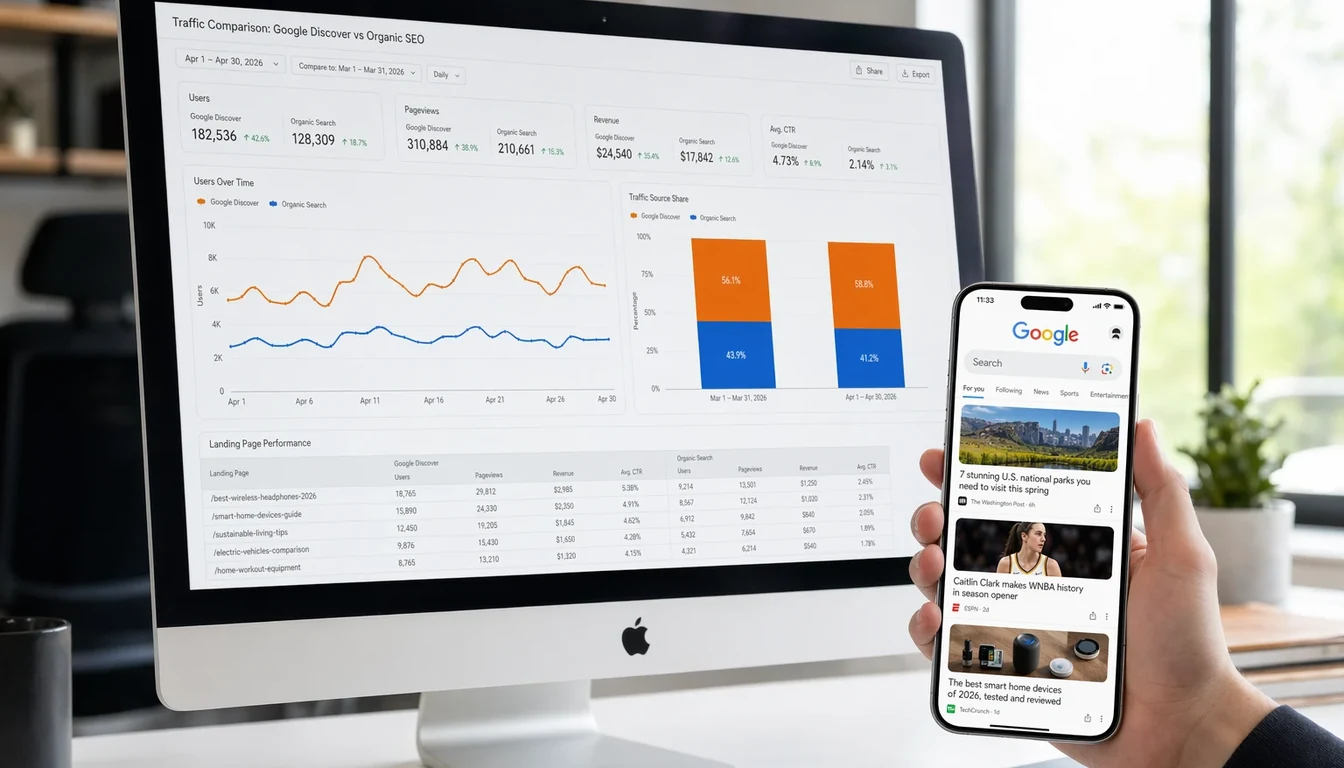
- Volume: Discover 42% vs SEO 51%. The rest (7%) comes from direct, social, newsletter.
- CTR: Discover 5.8% vs SEO 2.3%. Discover wins 2.5× on click-through.
- Ad RPM: Discover $12.40 vs SEO $8.90. Discover wins +39% per 1,000 PVs.
- Conversion rate on goals: Discover 0.7% vs SEO 2.4%. SEO wins 3.4× on conversion.
- Monthly volatility (std. dev.): Discover ±38% vs SEO ±9%. SEO is 4× more stable.
Why Discover doesn't replace SEO
Reason 1 — The absence of search intent
On Google Search, a user typing "best car insurance 2026" is in active buying mode. On Discover, they're scrolling passively and happen to see a card on the same topic: they may read, but rarely convert. The consequence is brutal: Discover conversion rates are 3 to 4× lower. For transactional business models (affiliate, e-commerce, lead gen), that gap is critical.
Reason 2 — Extreme volatility
In our panel, the 15 sites most dependent on Discover (>70% of traffic) experienced a monthly traffic drop greater than 40% at least once during the year. That volatility makes serious budget planning impossible: you can't commit to salaries, servers, or ad contracts on an audience that may vanish in 48 hours.
Reason 3 — No long tail
An SEO-optimized article well-ranked on long-tail queries can generate traffic for 3 to 7 years. A Discover article lives for 24-72 hours. Past that window, its traffic collapses by 95-99%. SEO builds an asset; Discover produces a firework.
"We have an SEO article published in 2021 that still generates 8,000 visits/month, with 350,000 cumulative visits to date. Our biggest Discover hit did 420,000 visits in 3 days — and 200 visits/month since. The two models don't play the same game." — Founder, consumer tech publisher
Why SEO doesn't replace Discover either
Reason 1 — SEO's volume ceiling
The queries you can rank for are bounded by real search volume. On most niches, reaching 500K visits/month with pure SEO takes 3-5 years of grinding. Discover can generate that same volume in 48 hours on a single viral article.
Reason 2 — The inability to discover new readers
SEO primarily serves people already looking for you (brand) or your topic (intent). Discover, on the other hand, pushes your content to audiences who didn't know you and hadn't thought to search that topic. It's a pure discovery engine.
Reason 3 — Mobile-first capture
On mobile, Discover already accounts for 25% to 40% of time spent on Google. Ignoring this channel means cutting yourself off from a massive slice of modern mobile attention.
The optimal portfolio by niche
Based on our panel observations, the optimal Discover/SEO mix varies significantly by vertical:
- Hot news & sports: 50-60% Discover + 40-50% SEO. The only segment where Discover can reasonably dominate.
- Lifestyle & cooking: 35-45% Discover + 55-65% SEO. Recipes = long-term SEO; trends = Discover.
- Consumer tech: 30-40% Discover + 60-70% SEO. SEO remains the engine for product reviews and guides.
- Personal finance & consumer: 15-25% Discover + 75-85% SEO. Conversion on these niches requires intent-driven traffic.
- B2B & SaaS: 5-15% Discover + 85-95% SEO. Discover doesn't capture pro buyers.
The common technical prerequisite
Whatever your mix, one point is non-negotiable: your site must have an active Google Web Profile. Without this identifier, your Discover eligibility is close to zero, and even your SEO signals take a hit (because Google partly uses the same authority signals to rank and to recommend). Check it in 1 second with our free Profiler.
Does your site have an active Google Web Profile?
No Discover tactic works if Google doesn't recognize you as an entity. 1 second to check, free.
Launch the Profiler →Data-backed verdict
Google Discover does not replace traditional SEO — it complements it, with radically different performance profiles. SEO is an asset: slow, stable, converting. Discover is an audience machine: explosive, volatile, free. The publishers winning hardest in 2026 aren't picking one over the other; they orchestrate both based on the nature of each piece of content they produce.
Our recent case study on +215% Discover traffic in 30 days also shows that the sites exploding on Discover are the ones that preserved their SEO foundation in parallel. To understand the fundamentals before building your mix, start with our complete definition of Google Discover.
Take action in 1 minute
Three free tools the editorial team uses daily — tested across French and international publishers.
📘 Want to go deeper? Grab the free Discover Essentials ebook (33 pages, 25-min read).
Sources and further reading
- 1492.vision — Sylvain Deauré & Damien Andell: Discover monitoring platform, analysis of 42 million cards (Dec 2025 - Feb 2026), FR-specific figures per pipeline
- Metehan Yesilyurt — metehan.ai: Google App SDK decompilation (87,498 Java classes), 8-stage pipeline, JSON-LD > OG priority
- SearchEngineLand — Inside Google Discover: 20 pipelines, 42 million cards: public relay of the 1492.vision analysis (aggregated figures)
- iPullRank, Mike King — Secrets from the Google Algorithm Leak: analysis of the May 2024 Content Warehouse leak (2,596 modules, 14,014 attributes)
- SparkToro, Rand Fishkin: public disclosure of the leak
- Hobo Web — Content Effort Signal: technical detail on the
contentEffortsignal and theQualityNsrPQDatamodule
Frequently asked questions
How long does it take for an SEO article to generate traffic?
Expect 3 to 6 months to see initial rankings on competitive queries, and 12 to 18 months to reach meaningful volume (5,000 visits per month and above for a flagship article). SEO is a long-term investment — the opposite of Discover, which can trigger a spike within 24 hours.
Can a Discover article also rank in organic search?
Yes, and that's the ideal outcome. An article optimized for editorial quality, well-structured with H2/H3, original images, and strong E-E-A-T, typically wins on Discover within 24 to 72 hours then keeps generating SEO traffic for months or years. The perfect double-dip.
What percentage of my traffic should ideally come from Discover?
The healthy ratio is 25 to 45% Discover, depending on your niche. Above 60%, you're dangerously dependent on a volatile channel — an algorithm change can cut half your revenue in 48 hours. Below 15%, you're missing out on a massive mobile lever.
Is Discover affected by Core Web Updates?
Yes, just as much as SEO. Google's Core Updates hit both SEO and Discover simultaneously, because the underlying authority signals are shared. A site losing in SEO after a Core Update usually loses — often more brutally — in Discover too, and vice versa for winning sites.
How do I precisely measure the Discover share in Analytics?
In Google Analytics 4, filter by source "google" + medium "organic" with the "googledistribution" dimension, or check the referrer. Complement with Google Search Console, which cleanly segments Discover vs Search. To isolate Discover revenue, build a segment based on the googleapis.com referrer or the Discover UTM injected by Google.