What is Google Discover? Definition, how it works, and why it matters in 2026
Google Discover has gone from mobile curiosity to major acquisition channel. Here's what it really is, how it works, and what it changes for your audience.
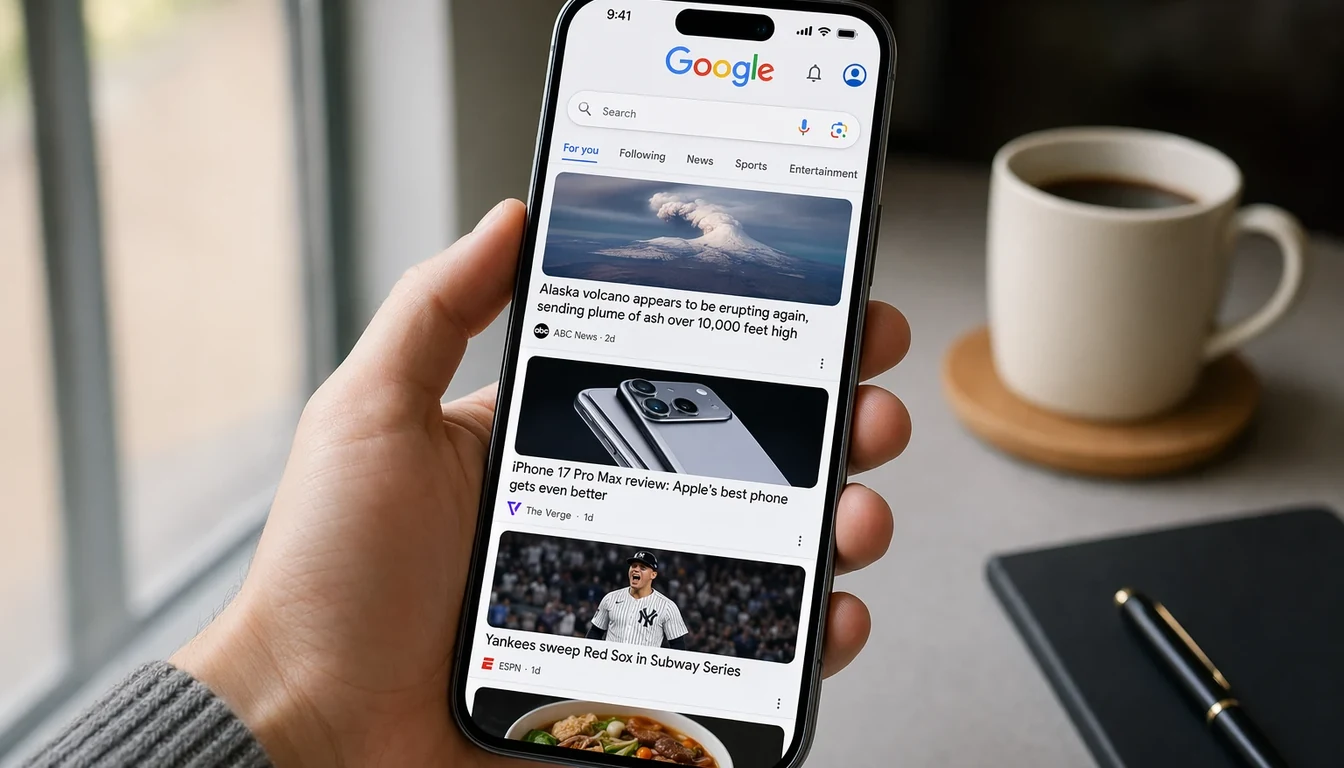
If you're reading this, odds are someone told you about a flood of free traffic that hit their site overnight — no new backlinks, no fresh keyword play, just Google one morning deciding to push their articles to millions of readers. That channel has a name: Google Discover. In 2026, it already drives 35% to 60% of the organic traffic for major publishers in most markets. So, what is it, exactly?
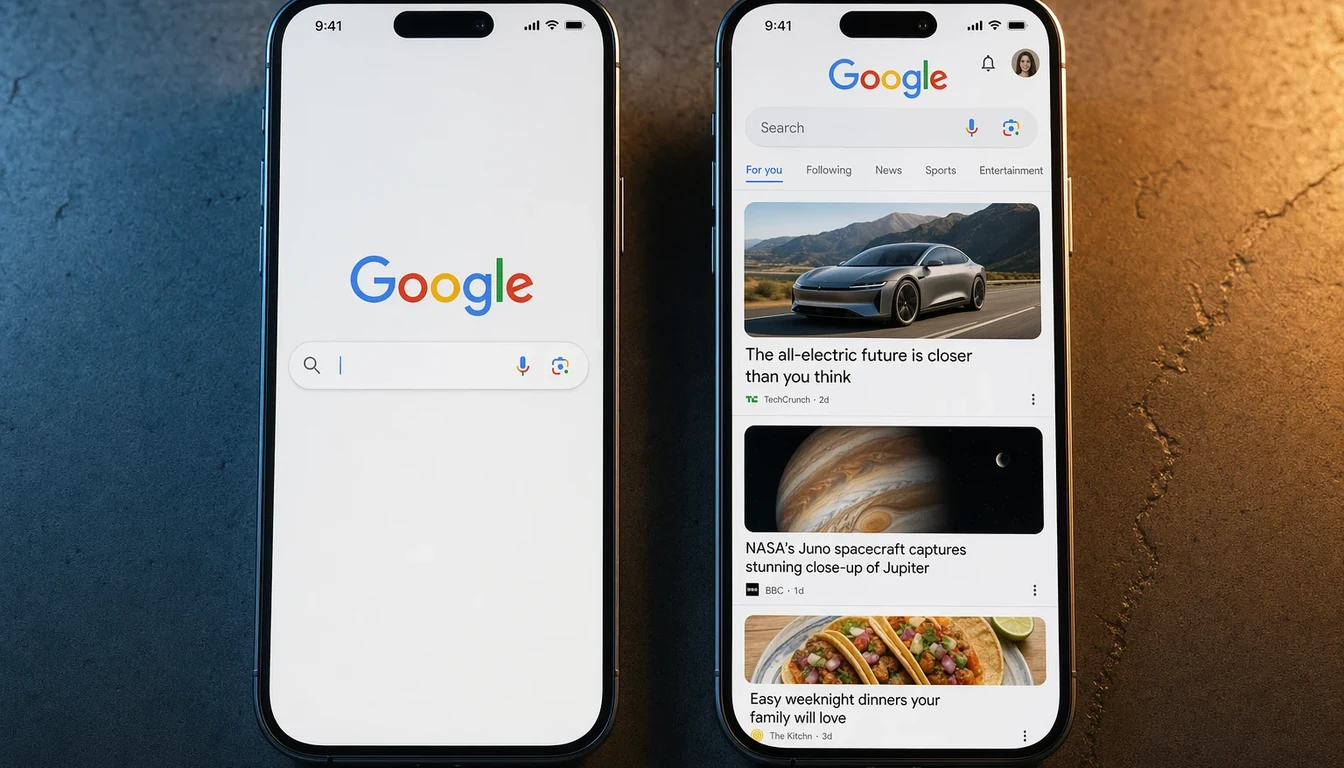
Google Discover is a feed of personalized content pushed automatically on mobile, with no query typed. It runs on algorithmic recommendation, uses a user's interest signals (Chrome history, YouTube, Google Apps) and rewards content that is fresh, visual and engaging. For a publisher, it's the most explosive — and most volatile — traffic channel of the decade.
Unless explicitly attributed to an external source, the specific percentages, thresholds and time windows mentioned in this article are DiscoReady's or the SEO community's own observations. For officially attested data on Discover's 2026 architecture, see our sourced analyses: Content, Moonstone, Aura — Layer 1 (55% of FR volume) and DeepTrends and DeepTrendsFable — the trends layer. The list of primary sources appears at the end of the article.
The official definition (and what it leaves out)
In Google's own docs, Discover is described plainly as "a feed of content tailored to your interests, available from the Google search bar on mobile". True, but a long way from the whole story.
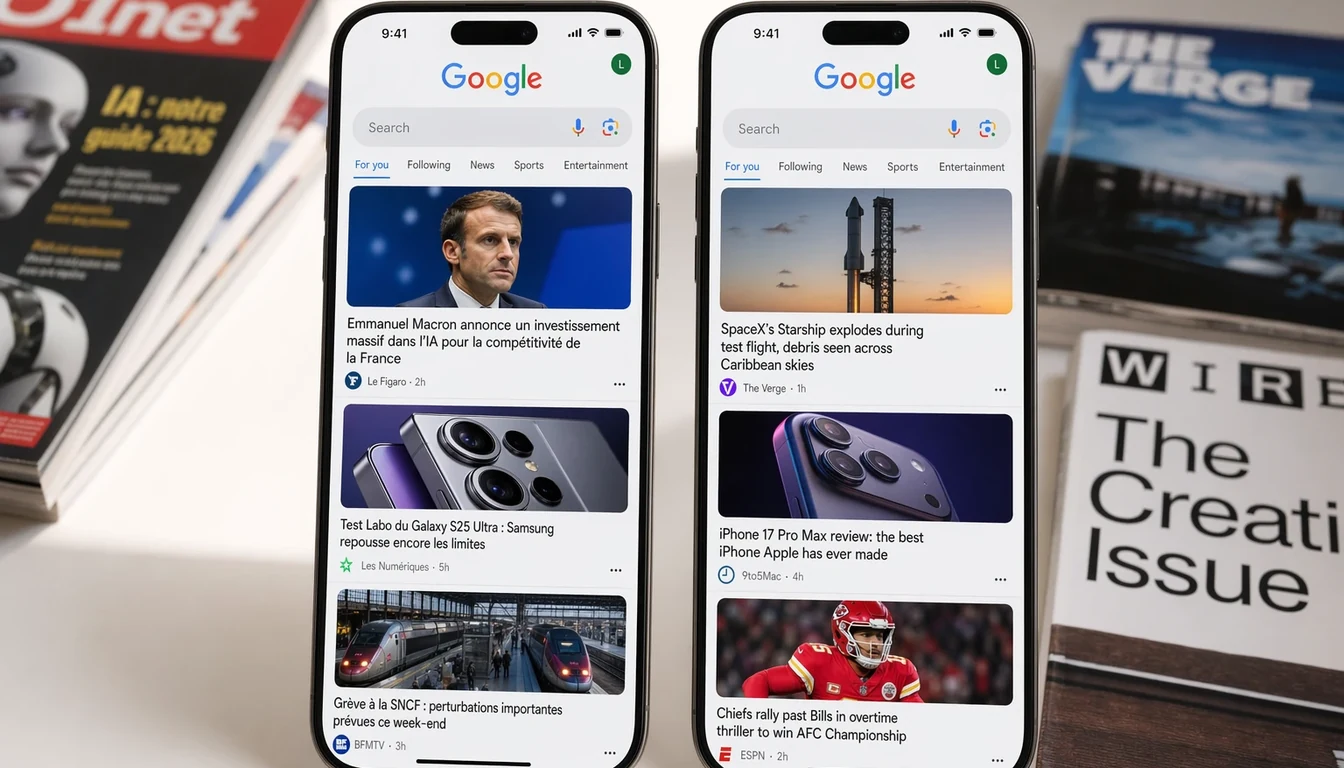
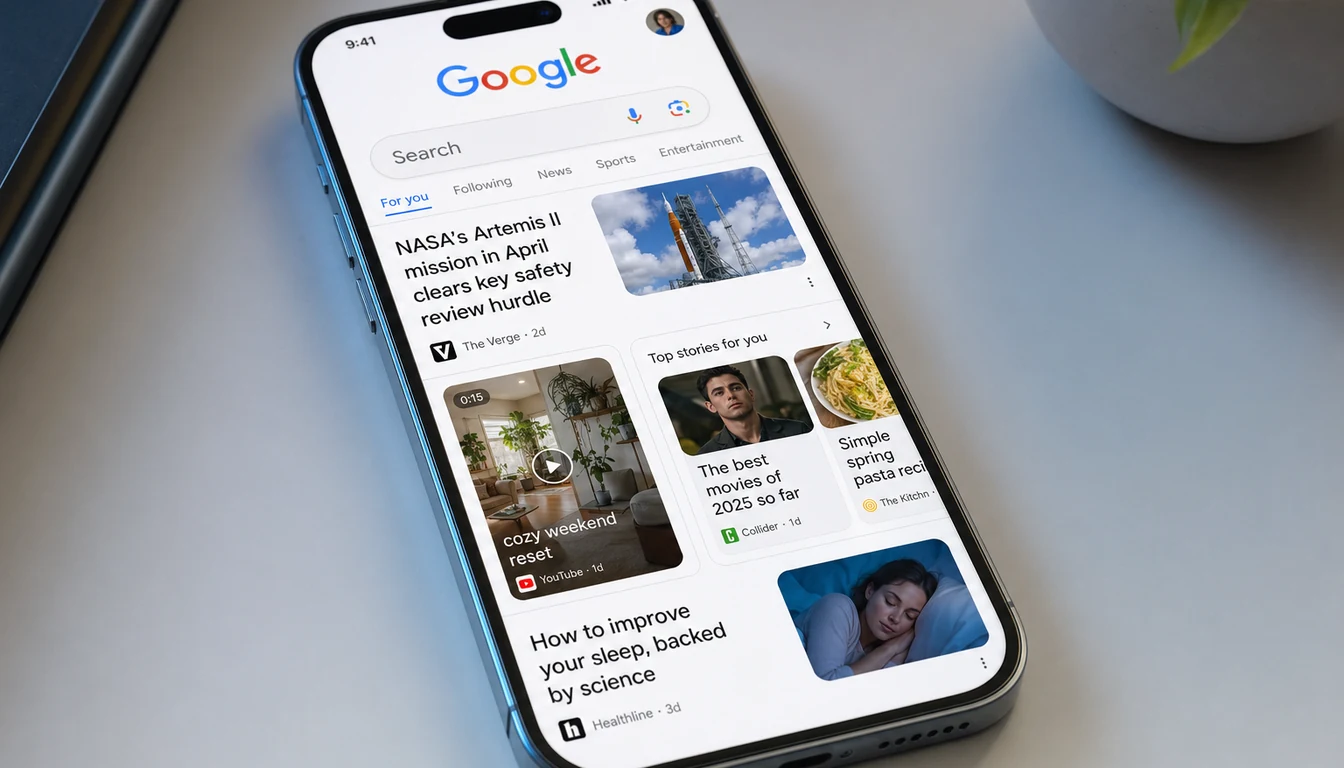
For a user, Discover looks like a stack of cards on their phone — in the Google app, on mobile Chrome, and on the home screen of most Android devices. Each card is an article, a video, a product, or a "story" with a large image, a punchy headline, and sometimes a short excerpt. No query has been typed: Google anticipates what the user will care about and serves it before they even search.
For a publisher, this mechanic redefines everything. You no longer "rank" for specific keywords like in traditional SEO: you either become (or don't) a trusted source the algorithm decides to push to audiences it judges interested. Search intent disappears; only the supposed relevance of your content to a user profile remains.
How Discover actually works
Behind the feed's apparent simplicity sits a formidably complex infrastructure. Three layers to understand if you want a seat at the table.
1. User signals (the algorithm's input)
Google builds an "interest profile" for each signed-in account. The main sources:
- Search history (Google Search + Chrome) over recent months
- YouTube — watched videos and subscribed channels
- Google Maps — searched and visited places
- Google Apps — News, Play Store, Shopping, Gmail
- Declarative signals — topics the user has explicitly followed or blocked
This profile is then matched in real time against an index of candidate content. Your articles live in that index — provided they tick a few technical boxes.
2. Ranking factors
Once a piece of content is a candidate, the algorithm scores it on several axes:
- Freshness — content under 48 hours is 4 to 7× more likely to be pushed
- Editorial quality — structure, depth, factual rigor, original visuals
- Measured engagement — CTR, read time, bounce rate, social shares
- Domain reliability — editorial history, publishing cadence, technical stability
- E-E-A-T — experience, expertise, authoritativeness, trustworthiness of the site and the author
3. Site identity: the Google Web Profile
Behind the curtain, Google assigns a unique identifier to every eligible site: the Google Web Profile (accessible via profile.google.com/cp/…). That profile is a strong recognition signal: a site that has one has been deemed "serious enough" to be considered a potential source. You can check in 1 second whether your site has one — it's the non-negotiable technical foundation for any Discover strategy.
The 4 strategic stakes for a publisher
Why are publishers scrambling so hard to appear in Discover? Because the economic stakes are enormous.
Stake 1 — Massive and free traffic
A slot in the Discover feed for a popular article translates into 50,000 to 2 million visits in 24 to 72 hours. That volume is comparable to TV coverage — except it's free and it lands with no warning.
Stake 2 — A CTR 2 to 4× higher than SEO
The average click-through rate on Discover hovers around 4% to 8%, versus 1% to 3% on classic search results. The user is in "passive browsing" mode — more curious, less resistant to visual hooks.
Stake 3 — Ad revenue spikes
Traffic spikes mean impression spikes. Many publishers report that 20% to 40% of monthly ad revenue comes from the days one or two articles land in Discover. The problem: it's unpredictable.
Stake 4 — Built-in instability
Discover is a binary channel: either your article takes off, or it doesn't. No warning, no alert. A publisher can do 500,000 visits one day and 2,000 the next. That volatility makes commercial planning hard — and is exactly why you should always keep a traditional SEO foundation running alongside.
"Discover is Russian roulette for traffic. Except every spin, the chamber has at least one blank, and sometimes a live round worth $100k in ad revenue." — Audience director, top-10 French publisher
What's changing in 2026
Since 2024, Google has accelerated the integration between Discover, AI Overviews and the Google Web Profile. Three shifts to watch:
- AI Overviews integration — AI-generated summaries are starting to replace some Discover cards on encyclopedic topics. The algorithm now favors sources identified as "canonical" for a domain.
- Google Web Profile goes mainstream — once optional, it's becoming a technical prerequisite for any serious Discover visibility in 2026.
- Stronger multimedia signals — Discover pushes more and more short formats (vertical videos, image carousels). Sites producing only long-form text see their reach decline.
Bottom line
Google Discover is not "a new SEO": it's a radically different channel, one that rewards editorial quality, freshness, and perceived site reliability. For a publisher in 2026, ignoring Discover means giving up a large majority of mobile traffic — but jumping in blind means firing shots into the dark.
The starting point is always the same: make sure your site has an active Google Web Profile, then build a content strategy designed for discovery (not for queries). That's the whole point of our complete guide on how Discover works, which dives into the concrete levers to pull.
Take action in 1 minute
Three free tools the editorial team uses daily — tested across French and international publishers.
📘 Want to go deeper? Grab the free Discover Essentials ebook (33 pages, 25-min read).
Sources and further reading
- 1492.vision — Sylvain Deauré & Damien Andell: Discover monitoring platform, analysis of 42 million cards (Dec 2025 - Feb 2026), FR-specific figures per pipeline
- Metehan Yesilyurt — metehan.ai: Google App SDK decompilation (87,498 Java classes), 8-stage pipeline, JSON-LD > OG priority
- SearchEngineLand — Inside Google Discover: 20 pipelines, 42 million cards: public relay of the 1492.vision analysis (aggregated figures)
- iPullRank, Mike King — Secrets from the Google Algorithm Leak: analysis of the May 2024 Content Warehouse leak (2,596 modules, 14,014 attributes)
- SparkToro, Rand Fishkin: public disclosure of the leak
- Hobo Web — Content Effort Signal: technical detail on the
contentEffortsignal and theQualityNsrPQDatamodule
Frequently asked questions
What's the difference between Google Discover and Google News?
Google News is a structured news aggregator that users navigate actively by topic or source. Google Discover is a personalized recommendation feed served without any query — the algorithm predicts what you'll care about. News targets information hunting; Discover targets passive consumption.
Do I need a Google account to see Discover?
No. Discover works without a Google account, but personalization relies on anonymous signals (IP geolocation, browser language). With a signed-in account, the feed becomes much more relevant since the algorithm uses YouTube, Chrome, and Maps history.
Does Discover exist on desktop?
No, Discover is mobile-only. It appears in the Google app (Android, iOS), in mobile Chrome, and on Android home screens. There's no official desktop version in 2026 — Google is keeping Discover focused on touch-based usage.
How do I know if my site appears in Discover?
Log in to Google Search Console and look for the "Discover" report under "Performance". If your site is surfacing in Discover, you'll see impressions, CTR, and the articles involved. The absence of the report means your site hasn't (yet) been pushed into the feed.
What types of content does Google Discover promote the most?
Discover favors three broad families: fresh news under 48 hours old, high-value visual and evergreen content (practical guides, analysis pieces, listicles), and trending content tied to cultural moments. Informational how-to content also finds a place, provided it's written with verifiable expertise.
Does your site have an active Google Web Profile?
No Discover tactic works if Google doesn't recognize you as an entity. 1 second to check, free.
Launch the Profiler →