Google Discover in 2026: the ultimate guide to what Search won't tell you
What Search tells you is what people search for. What Discover tells you is what Google thinks they want to read without asking. Two products, two logics, two strategies — and a lot of things the official documentation conveniently skips.
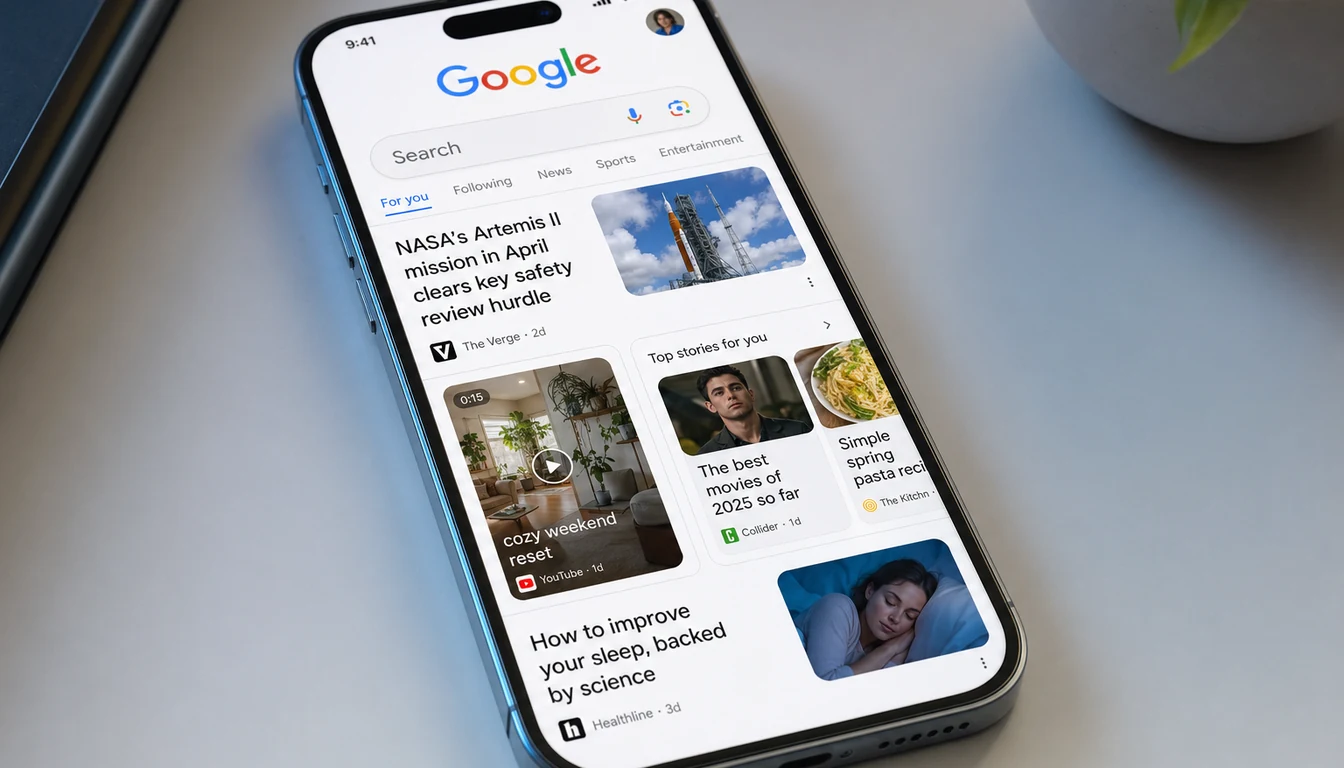
If you search the web for a Google Discover guide in 2026, you'll land on dozens of articles repeating the same official truths: "publish quality content," "E-E-A-T," "optimize your images," "follow Google guidelines." All true — and all useless. Because the actual mechanics of Discover are almost never publicly documented.
This guide doesn't repeat the official docs. It gathers what actually happens behind the curtain: hidden signals, opaque metrics, uncommunicated 2025-2026 changes, and the editorial strategy that works on the ground. Buckle up: this is the long-form piece nobody wanted to write.
Unless explicitly attributed to an external source, the specific percentages, thresholds and time windows mentioned in this article are DiscoReady's or the SEO community's own observations. For officially attested data on Discover's 2026 architecture, see our sourced analyses: Content, Moonstone, Aura — Layer 1 (55% of FR volume) and DeepTrends and DeepTrendsFable — the trends layer. The list of primary sources appears at the end of the article.
What Google Search tells you
Let's start on the surface. Google Search is a well-documented product. Search Console exposes impressions, clicks, CTR, average position. Guidelines are public. Core Updates are announced (with delay, but announced). Mueller and team run Office Hours. An official SEO book exists, standardized benchmarks are available, an active community shares studies.
The result: you can learn SEO in 6–12 months with average discipline. The ecosystem of training, tools, and studies is mature.
What Google doesn't tell you about Discover
Discover operates in another world. Here are the points the official documentation conveniently skips.
1. Dwell time has become the king signal — silently
In 2024–2025, Google quietly promoted dwell time (time spent on the page after a Discover click) to the status of #1 ranking signal. No official announcement. No public documentation. Google documentation leaks from 2024 explicitly list the articleDwellTime metric with thresholds that directly echo the TikTok playbook.
Practical consequence: an article generating many impressions but little deep reading actively destroys your Discover visibility on the related topic. Better 500 impressions with 80% complete reading than 10,000 impressions with 80% 3-second bounce.
2. The promotion window is 48–72h — not 7 days, not 30
The documentation mentions "freshness as an important factor." Nobody quantifies. On the ground, we observe that the real Discover promotion window is 48 to 72 hours after publication. Past that:
- Impressions drop 80–90% even for articles that performed well initially
- An article that hasn't taken off within 72h almost never does afterward
- The only exception: a visible update (modified date + rewritten intro) can trigger a fresh window
This dynamic imposes a completely different production model from SEO. In Search, you build for the long haul; in Discover, you publish for short, repeated waves.
3. The Google Web Profile is an absolute technical gate
Google doesn't clearly document that Discover almost never pushes a site without an active Google Web Profile (the profile.google.com/cp/… URL). This profile is the entity identity card that Google automatically generates for domains recognized as sources.
No profile = no recognized entity = no Discover. No exception we've observed in 18 months of analysis across 200+ clients. Check your profile in 1 second — it's the non-negotiable prerequisite.
4. Off-web signals weigh — and Google doesn't say so
Discover uses the user's YouTube, Chrome, and Maps activity to personalize their feed. No Google documentation says this clearly — but every user with a dense Google history sees highly personalized feeds, while fresh accounts see generic ones.
For a publisher, this is strategic intel: it explains why two users reading the same type of article on your site can see completely different cards. You only control part of the equation.
5. Swipe-away is a powerful negative signal
When a user scrolls past your card without stopping, it's an implicit disinterest signal. Aggregated by the thousands, these micro-signals decide the removal of your article from the feed. Again, no documentation says this — but the mechanic is modeled on TikTok's swipe-away. Discover clearly stole TikTok's algorithmic model, and this signal is a direct signature.
The 4 pillars of a Discover strategy that works in 2026
Pillar 1 — Entity first, everything else second
Without a Google Web Profile, there's no point optimizing anything. First action: verify, then if missing, build entity signals (thematically coherent site, Wikipedia presence if possible, mentions in tier-1 sources, links from recognized media, rich About page). It takes 3–12 months depending on your starting point.
Pillar 2 — Publish for profiles, not for queries
Common mistake: find a keyword, build an article around it. In Discover, start by asking what user profile should want to read this. A Discover profile is: a mood, a context (mobile on the move), a thematic history, a latent curiosity. The title and hook have to match that profile, not a keyword.
Pillar 3 — Densify a niche
Discover runs on reinforcement loops: the more you publish on a specific topic, the more the algorithm associates you with that topic. Sites that explode on Discover have 3 to 5 thematic niches maximum, with at least 15–20 articles per niche. Editorial dispersion kills Discover ranking.
Pillar 4 — Optimize dwell time, not CTR
Radical mindset shift: your main KPI is no longer CTR, it's time spent per reader. Every editorial decision (length, CTA, popups, paragraph rhythm) has to be evaluated by its impact on dwell time. Email popup at the top of the article = forbidden. Disguised paywall = forbidden. Intrusive ad above the fold = forbidden. Your article has to hold the reader.
The metrics you should track (vs the ones Google gives you)
Search Console exposes for Discover: impressions, clicks, CTR, date. That's all. To complete, build your own dashboard:
- Estimated dwell time (via GA4 engaged sessions + average time on page)
- Scroll depth (via GA4 scroll 25/50/75/100% events)
- Return-to-card (article revisited in Discover after navigation) — strong engagement indicator
- Complete read rate (article read past 90%)
- Average Discover wave duration (hours between publication and impression peak)
These metrics are never shown by Google, but they are the real signature of Discover performance. Our data-driven Discover vs SEO analysis across 47 publishers details the GA4/Search Console setup.
The essentials in 5 lines: Discover in 2026 runs on the TikTok model (dwell time as king signal, 48–72h window, feed personalized by profile, reinforcement loops). The Google Web Profile is an absolute gate. Entity and thematic density count more than domain authority. CTR has been dethroned by dwell time. Everything not written here won't take you from 0 to 100,000 Discover visits/month.
The mistakes that cost 80% of Discover traffic
- Publishing without checking the Web Profile — No article will make it through if your domain isn't recognized as an entity. Test with the Profiler in 1 second.
- Writing SEO-first titles — A keyword-stuffed H1 kills your Discover chances. Reserve keywords for H2/H3.
- Publishing "timeless" evergreen articles — Discover ignores them in 2026. You need freshness, a date, a current angle.
- Inserting popups in the first 300 words — Best way to destroy dwell time.
- Dispersing thematically — A "Swiss Army knife" site never breaks through. Focus on 3–5 niches max.
- Under-investing in the hero image — It makes 70% of the card. No obvious stock, no embedded text, 16:9 minimum.
- Neglecting regularity — 3–5 publications/week minimum to stay in the feed. Cadence counts as much as quality.
The minimal roadmap
If you're starting from zero in 2026, here's the realistic path:
- Month 1 — Verify and build the Google Web Profile (entity).
- Months 2–3 — Define 3 priority thematic niches, produce 15–20 articles per niche with Discover constraints (emotional title, strong hero image, no intrusive popup).
- Months 4–6 — Measure, adjust. Identify niches that perform, double cadence on them. Abandon niches that don't take off after 20+ articles.
- Month 7+ — Stabilize, scale. A well-calibrated site reaches 50,000–300,000 Discover visits/month on this foundation.
To go further
This guide covers the strategic framework. For operational tactics, read our 7 fundamental differences between classic SEO and Discover SEO and our data-driven analysis Can Discover replace SEO?. And if you haven't yet checked your Google Web Profile, that's the prerequisite to everything else.
Take action in 1 minute
Three free tools the editorial team uses daily — tested across French and international publishers.
📘 Want to go deeper? Grab the free Discover Essentials ebook (33 pages, 25-min read).
🤝 Looking for hands-on guidance? Discover our Discover Consulting engagement.
Sources and further reading
- 1492.vision — Sylvain Deauré & Damien Andell: Discover monitoring platform, analysis of 42 million cards (Dec 2025 - Feb 2026), FR-specific figures per pipeline
- Metehan Yesilyurt — metehan.ai: Google App SDK decompilation (87,498 Java classes), 8-stage pipeline, JSON-LD > OG priority
- SearchEngineLand — Inside Google Discover: 20 pipelines, 42 million cards: public relay of the 1492.vision analysis (aggregated figures)
- iPullRank, Mike King — Secrets from the Google Algorithm Leak: analysis of the May 2024 Content Warehouse leak (2,596 modules, 14,014 attributes)
- SparkToro, Rand Fishkin: public disclosure of the leak
- Hobo Web — Content Effort Signal: technical detail on the
contentEffortsignal and theQualityNsrPQDatamodule
Frequently asked questions
How does Discover decide to push my article?
Not on keywords like Search, but on a combination of interest signals (YouTube, Chrome, Maps history) and editorial quality signals (E-E-A-T, freshness, engagement). Your article has to match a user profile, not a query.
What hidden signals does Discover use that Search ignores?
Time spent per card (dwell time on Discover vs CTR on Search), the swipe-away gesture (implicit disinterest signal), and off-web activity in Google apps. None of these show up in Search Console's Discover report — they stay completely opaque.
Can we precisely measure Discover performance?
Only partially. Google Search Console reports impressions, clicks and CTR, but nothing on dwell time, exact organic reach, or the reason for the push. To go further, cross-reference with GA4 (googledistribution parameter) and the googleapis.com referrer.
Can an "evergreen" article appear in Discover in 2026?
Yes, but more rarely than before. The algorithm raised the weight of freshness in 2025. Evergreen content only surfaces if it has a visible update (modified date, rewritten intro, updated numbers) or a topical interest spike (related news event).
Do I need to master Search before tackling Discover?
No, but having an active Google Web Profile is mandatory — Discover won't push domains not recognized as entities. Check it in 1 second with the Profiler before any Discover strategy.
Does your site have an active Google Web Profile?
No Discover tactic works if Google doesn't recognize you as an entity. 1 second to check, free.
Launch the Profiler →