From search to recommendation: how Discover stole the TikTok model from editorial content
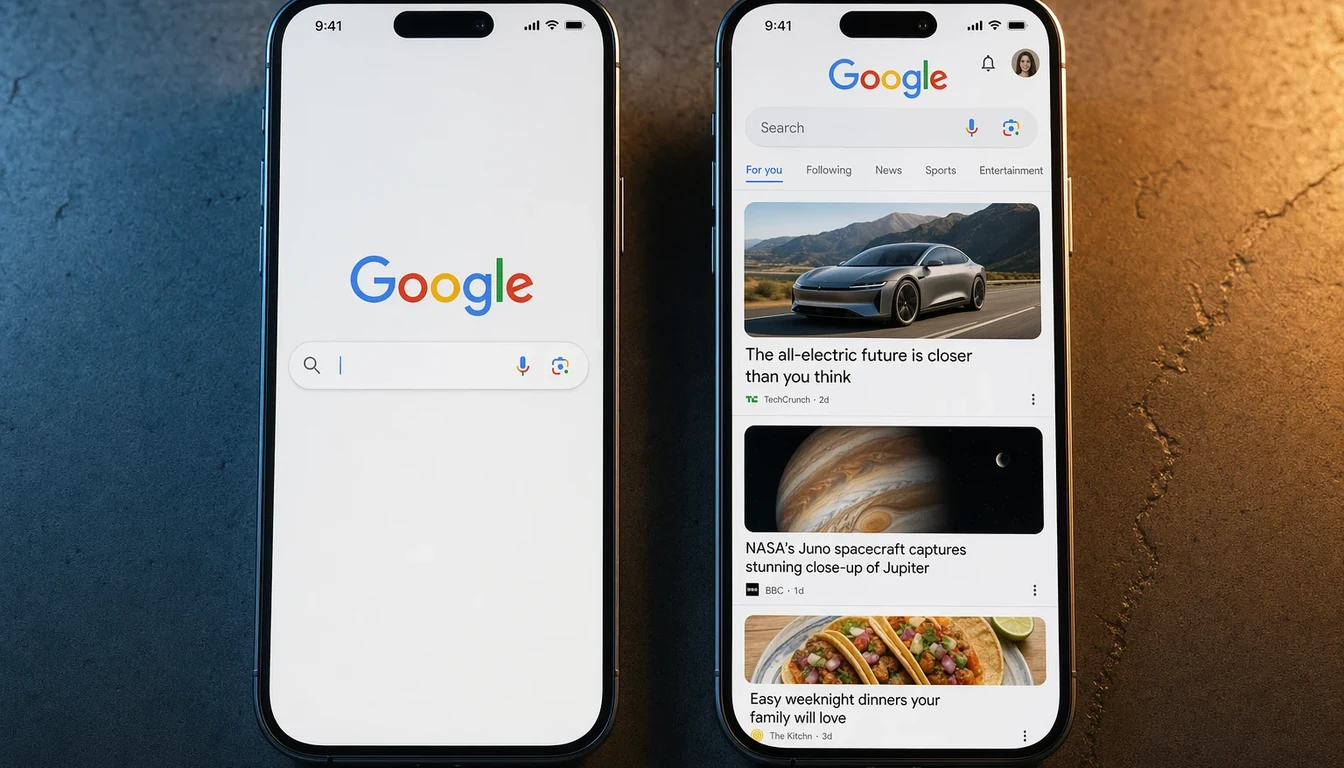
In 2018, Google renamed "Google Feed" to "Discover". Seven years later, the reason is clear: they were preparing to shift toward the model that would dominate global attention. Not Search. TikTok. Here's how Discover became the For You Page of editorial content.
In 2018, Google made a seemingly innocuous rename: "Google Feed" became "Google Discover." At the time, nobody really understood the strategic pivot being prepared. Seven years later, the reading is crystal clear: Google was preparing its shift toward the algorithmic model that would dominate the attention economy. Not Search. TikTok.
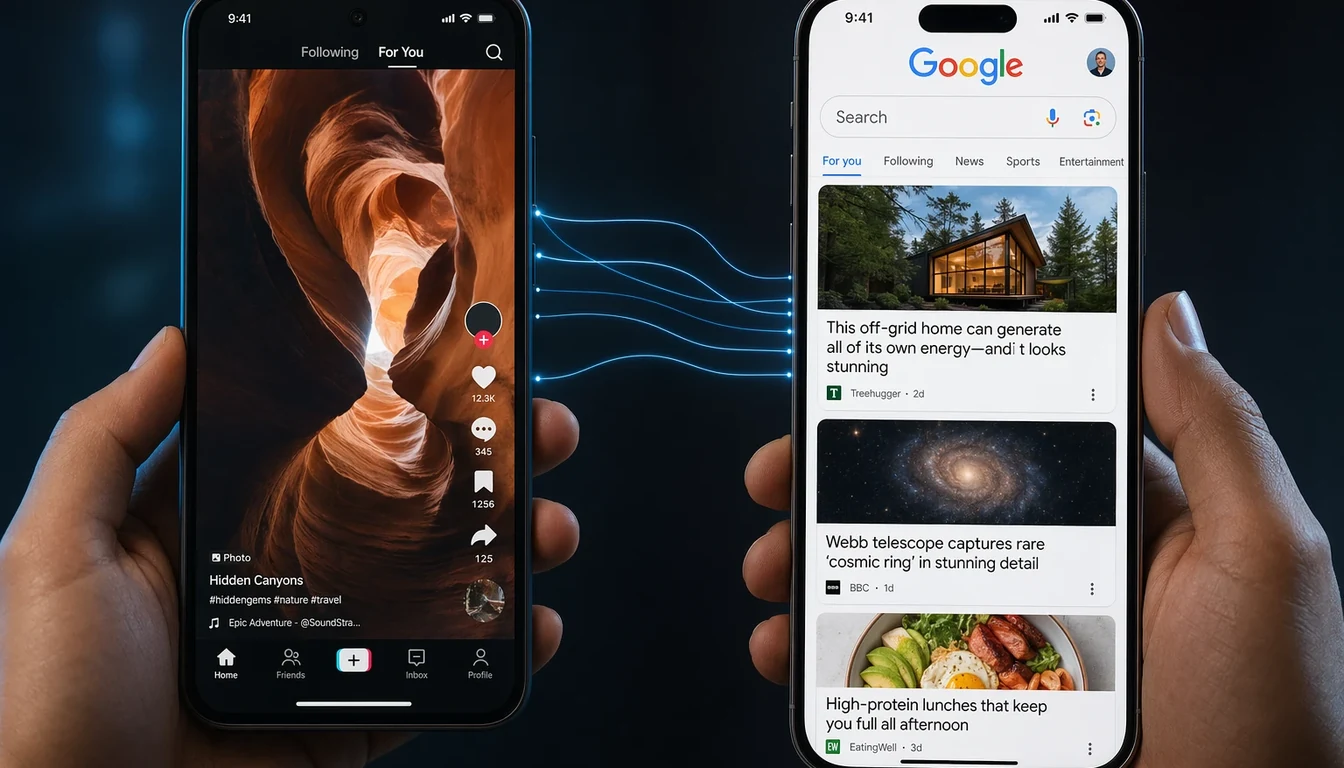
Today, Discover is no longer an editorial feed. It's the For You Page of the open web, running on the same mechanics that pushed Instagram, YouTube, and Twitter into the recommendation era. Here's how the shift happened, and what it changes for anyone producing editorial content.
Unless explicitly attributed to an external source, the specific percentages, thresholds and time windows mentioned in this article are DiscoReady's or the SEO community's own observations. For officially attested data on Discover's 2026 architecture, see our sourced analyses: Content, Moonstone, Aura — Layer 1 (55% of FR volume) and DeepTrends and DeepTrendsFable — the trends layer. The list of primary sources appears at the end of the article.
The pivot: from search to recommendation
For 20 years, the web ran on a pull model: the user searches, the machine answers. Google Search took this model to its peak — a planetary index, sophisticated ranking algorithms, and a user who types a query to trigger distribution.
TikTok flipped the model in 2018–2019. Switch to push: the machine decides, the user consumes. No query, no explicit intent — an infinite, personalized feed that feeds on every gesture (time spent, swipe, rewatch, follow). That's the For You Page, and it changed the game at global scale.
Google Discover is structurally the port of that model to long-form editorial content: no vertical videos, but articles. No viral sounds, but numbers and angles. But the algorithmic mechanics are identical.
The TikTok signatures you'll find inside Discover
1. The infinite personalized feed
On TikTok, you scroll infinitely through content tailored to you. On Discover, same mechanic: the feed has no theoretical end, and every user sees a globally unique selection, recalculated each session based on their YouTube, Chrome, Maps, and Google app history.
The editorial consequence: no more home page. An article is no longer "on homepage," it's "in the feed of X users whose profile matches its theme." The very concept of editorial visibility is pulverized.
2. Dwell time as the king signal
Before TikTok, the industry measured engagement through clicks and shares. TikTok imposed a new central metric: watch time per video. A video watched to 90% = strong signal. A video skipped at 2 seconds = rejection signal.
Discover copied that mechanic onto text. The #1 signal in 2025–2026 is no longer CTR — it's dwell time after click. An article opened and closed in 3 seconds signals to the algorithm that the card was misleading or the content disappointing, and the site gets penalized. An article read for 2–3 minutes with deep scroll, on the contrary, triggers additional impression waves.
CTR has been dethroned. In Discover 2026, publishing an article that generates 10,000 impressions, 500 clicks, but 80% immediate bounces costs the site more than an article with 500 impressions and 50 complete reads.
3. The swipe-away penalty
TikTok turned the swipe-away into an implicit disinterest signal — content quickly rejected by many users gets deprioritized for everyone. Discover has the same mechanic: a user scrolling past your card without stopping sends a weak negative signal. Thousands of these aggregated micro-signals decide an article's fate.
4. The reinforcement loops
Both platforms run on loops: a user watching a DIY video sees 10 more DIY videos. Same on Discover — reading a cooking article pushes 10 cooking cards. Which means dense editorial niches are advantaged: the more you publish on a topic, the more Google sends you qualified traffic on that precise topic.
What Google (still) refuses to admit
In its public communications, Google speaks exclusively of "personalized recommendation." Never TikTok. Never For You Page. But the technological signals are there:
- The 2024 mobile redesign — the Discover feed moved to vertical full-screen on mobile, with swipe transitions. That's the TikTok design applied to text.
- Internal leaks (Google documentation surfaced in 2024) explicitly list an
articleDwellTimemetric with thresholds modeled on the TikTok playbook. - Google Discover's 2023–2025 hires targeted former ByteDance and YouTube Shorts engineers. The skill transfer is documented on LinkedIn.
The major difference that remains
Not everything is copied. Two fundamental differences subsist:
1. Discover redirects to the open web. TikTok is a captive platform — it hosts the content, monetizes inside, and tries to retain the user. Discover instead pushes the user out of the Google ecosystem, toward publisher websites. That's what makes Discover an acquisition channel for publishers, not an attention black hole.
2. The format stays long. Discover pushes articles of 1,500 to 3,000 words. Content remains editorial text, not vertical video. The TikTok format was not imposed — only the algorithmic mechanic was ported. It's a crucial nuance: you don't need to produce TikTok-format content to perform in Discover.
Short version: Discover is TikTok applied to long-form articles. Same signals, same profile-content matching logic, same reinforcement loop. But long-form content, redirection to the publisher site, and monetization via the open web. A unique hybrid in the digital economy.
What this means for your strategy
If you produce editorial content in 2026, integrating the TikTok lesson means applying 4 principles:
- Think "profile" before "keyword" — who's the reader that should stop on your card? What mood are they in while scrolling?
- Optimize dwell time, not CTR — an article that keeps the reader for 2 minutes is worth more than a trap-title that generates a 3-second bounce.
- Densify your thematic niche — the more you publish on one topic, the more the algorithm pushes you on that topic. Editorial dispersion is Discover's worst enemy.
- Publish at a steady cadence — freshness (48–72h) is demanding. A sustained rhythm (3–5 articles per week minimum) is a prerequisite to stabilize in the feed.
Our 7 concrete techniques to boost your Discover traffic translate these principles into weekly actions.
Bottom line
Google bet that the future of the web belongs to recommendation, not search. For an editorial publisher in 2026, refusing to understand the TikTok mechanic means playing the game short one player. The rules have changed; the winners will be those who internalize them first.
The technical prerequisite remains the same: Google must recognize you as a credible editorial entity before integrating you into its recommendation engine. Check your Google Web Profile in 1 second — it's the mandatory pass before any Discover strategy.
Take action in 1 minute
Three free tools the editorial team uses daily — tested across French and international publishers.
📘 Want to go deeper? Grab the free Discover Essentials ebook (33 pages, 25-min read).
Sources and further reading
- 1492.vision — Sylvain Deauré & Damien Andell: Discover monitoring platform, analysis of 42 million cards (Dec 2025 - Feb 2026), FR-specific figures per pipeline
- Metehan Yesilyurt — metehan.ai: Google App SDK decompilation (87,498 Java classes), 8-stage pipeline, JSON-LD > OG priority
- SearchEngineLand — Inside Google Discover: 20 pipelines, 42 million cards: public relay of the 1492.vision analysis (aggregated figures)
- iPullRank, Mike King — Secrets from the Google Algorithm Leak: analysis of the May 2024 Content Warehouse leak (2,596 modules, 14,014 attributes)
- SparkToro, Rand Fishkin: public disclosure of the leak
- Hobo Web — Content Effort Signal: technical detail on the
contentEffortsignal and theQualityNsrPQDatamodule
Frequently asked questions
Does Google officially admit drawing inspiration from TikTok?
No, and that's telling. Google's official communications talk about "personalized recommendation" without ever citing TikTok. But the algorithmic signatures are identical: infinite vertical feed, dwell time as king signal, swipe-away penalty, engagement reinforcement loops. The 2024 Google mobile interface change mapped feed direction to TikTok's (vertical, full-screen on mobile).
What major difference remains between Discover and TikTok?
Two. First, Discover doesn't host the content — it redirects to the publisher's site (no captive platform). Second, TikTok prioritizes in-app retention while Discover monetizes the hand-off to the open web. But the profile-content matching engine is structurally similar.
Do I need to produce "TikTok-format" content to perform in Discover?
No — and that's the trap. Discover remains a feed of long-form textual articles with images. The TikTok lesson is about algorithmic mechanics (engagement-first), not format. Write 1,500–2,500-word articles with an emotional H1, original images, and a strong hook in the first 100 words.
Is dwell time really the #1 signal?
Yes, in 2025–2026. Public tests by John Mueller and internal Google leaks suggest that time spent on the page after a Discover click weighs more than CTR itself. An article opened and closed in 3 seconds penalizes your site more than an impression with no click.
Is this shift toward the TikTok model a threat to publishers?
Ambivalent. Threat: unpredictability goes up — an article can explode or die without apparent logic. Opportunity: keyword authority matters less, a small site can break through if the content matches the user profile. Our 7 techniques to boost Discover traffic break down the actionable levers.
Does your site have an active Google Web Profile?
No Discover tactic works if Google doesn't recognize you as an entity. 1 second to check, free.
Launch the Profiler →