7 techniques to blow up your Google Discover traffic
Concrete, actionable, proven strategies to turn Discover into a real acquisition channel and generate thousands of qualified visitors every day.
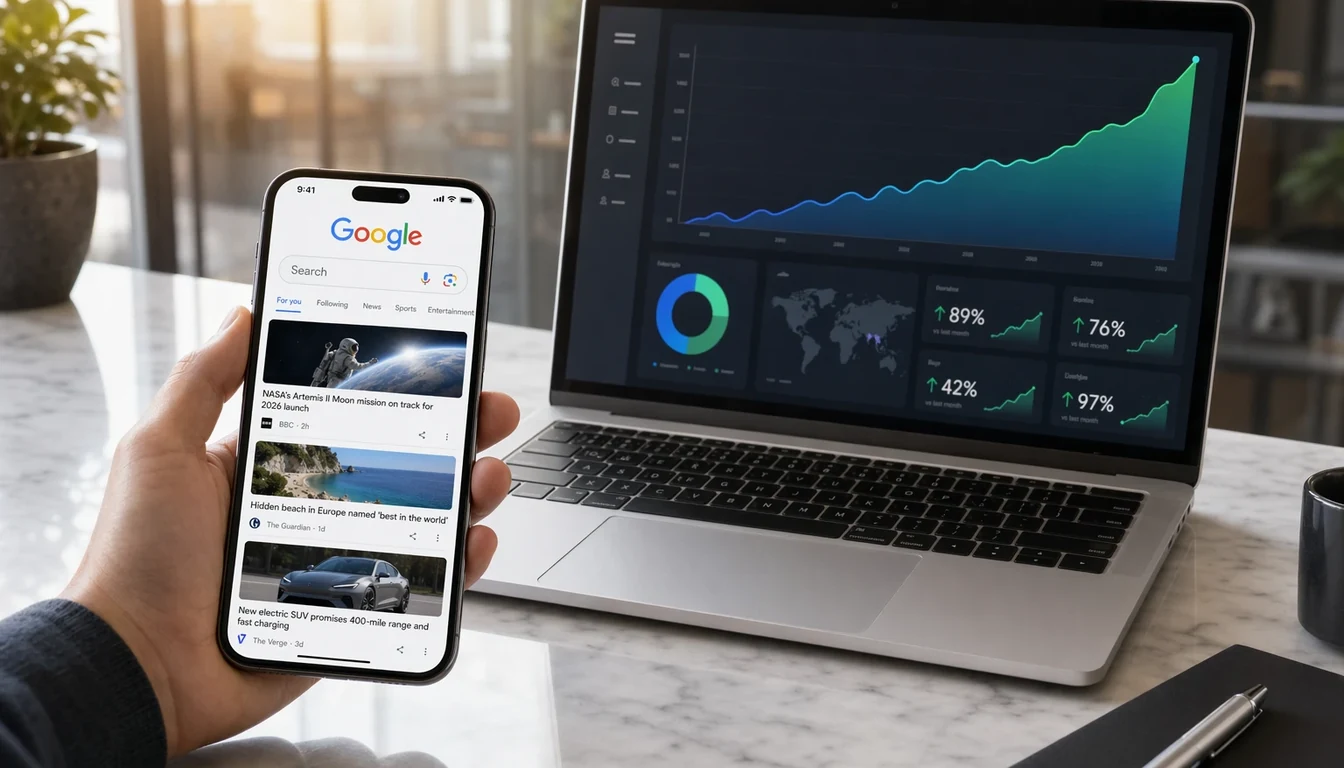
Google Discover can multiply your traffic 10× in a few weeks — or stay completely silent. The difference? Methodical execution on 7 specific levers. Here are the ones that concretely work in 2026, based on hundreds of sites analyzed.
Unless explicitly attributed to an external source, the specific percentages, thresholds and time windows mentioned in this article are DiscoReady's or the SEO community's own observations. For officially attested data on Discover's 2026 architecture, see our sourced analyses: Content, Moonstone, Aura — Layer 1 (55% of FR volume) and DeepTrends and DeepTrendsFable — the trends layer. The list of primary sources appears at the end of the article.
Headlines that intrigue without betraying
The headline is what the user sees before clicking. It must be precise, concrete, and suggest clear value — without falling into clickbait that will kill your traffic as soon as a user bounces back.
What works: "Why X…", "How Y…" formulations, numbers, trigger words ("finally", "really", "method"), deliverable promises.
Images at 1200px minimum (and declared)
Discover displays large visual tiles. Without high-resolution images, your article will almost never be featured prominently. The main image must be at least 1200 pixels wide, ideally 1920×1080.
Add this tag to your <head>:
<meta name="robots" content="max-image-preview:large">
Publish when your readers are connected
Discover prioritizes articles published in the last 24 to 48 hours. The window is tight. Publishing at 6 AM to catch morning commutes, or late afternoon for the end-of-day pause, often doubles initial impressions.
Nail your technical health (Core Web Vitals)
An article that takes 4 seconds to load on 4G mobile loses 50% of its readers before they even start. Your targets:
- LCP < 2.5s (Largest Contentful Paint)
- INP < 200ms (Interaction to Next Paint)
- CLS < 0.1 (Cumulative Layout Shift)
Main causes of poor scores: unoptimized ads, uncompressed images, blocking third-party JavaScript.
Structure with schema.org
Structured data helps Google understand your content type (article, news, recipe, event…) and associate the right signals. Minimum essentials:
- Type
ArticleorNewsArticlein JSON-LD - Fields
headline,datePublished,dateModified,author,image - Marked-up breadcrumb
Build your authority (E-E-A-T)
Discover massively favors sites perceived as trusted sources. Signals that count:
- A detailed About page
- Identified authors with bio + social links
- Complete legal mentions
- An active Google Web Profile (verify with our Profiler)
- A Wikipedia profile (huge bonus if eligible)
Monitor and iterate with Search Console
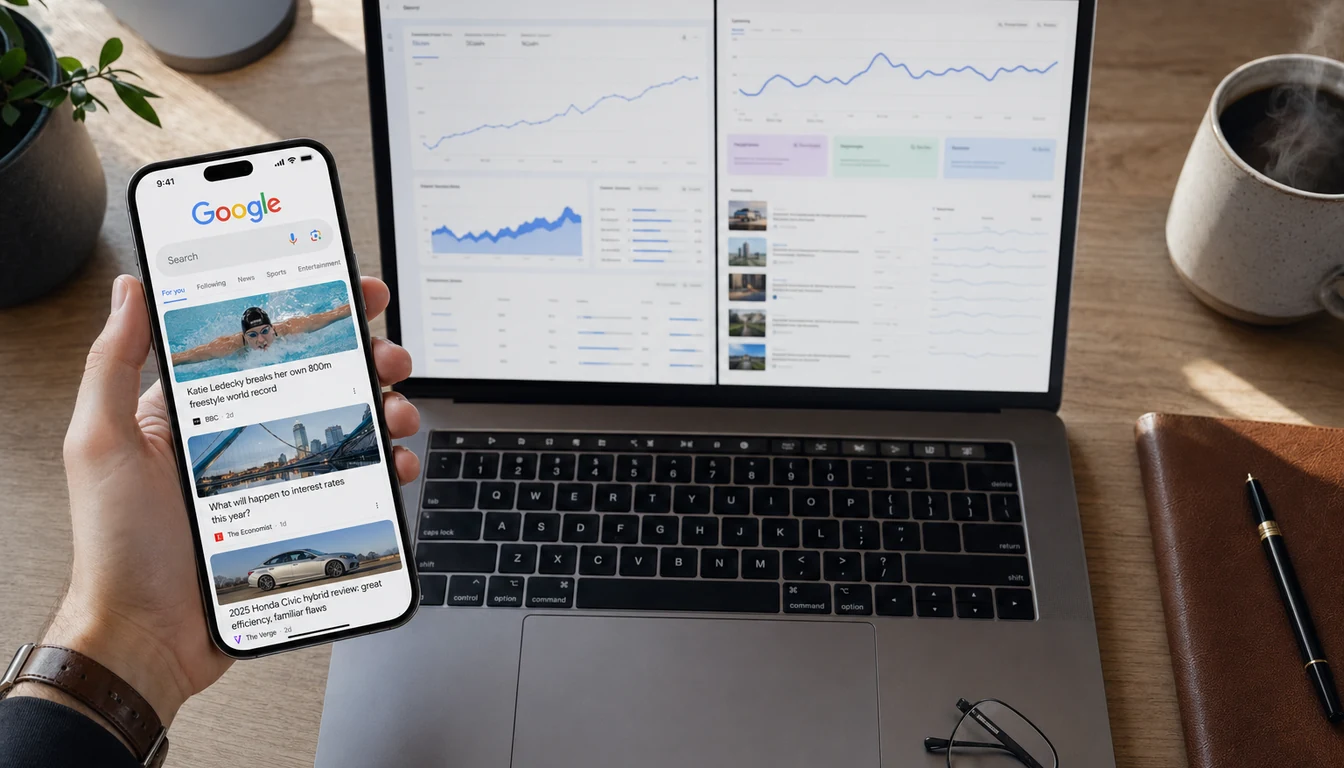
Without data, you're flying blind. The Performance → Discover tab in Search Console tells you exactly:
- Which articles drive Discover traffic
- How many impressions vs clicks
- Weekly trends
Identify your top-5 Discover articles, analyze their common patterns (format, length, image type, editorial angle), and systematically replicate these patterns.
"The best article for Discover is the one that would have been shared on WhatsApp even if Google didn't exist." — Adapted from Marie Haynes, SEO consultant
In summary
- Precise, non-clickbait headlines
- Images ≥ 1200px, declared with
max-image-preview:large - Publish at the right hours
- Core Web Vitals green
- Clean schema.org markup
- Visible authority (authors, About, Web Profile)
- Continuous monitoring via Search Console
Each of these 7 techniques brings a marginal gain. Applied together, rigorously, over 3 to 6 months, they radically transform a site. Typical results: substantial Discover traffic gains over 90 days (observed in our internal audits).
Take action in 1 minute
Three free tools the editorial team uses daily — tested across French and international publishers.
📘 Want to go deeper? Grab the free Discover Essentials ebook (33 pages, 25-min read).
🤝 Looking for hands-on guidance? Discover our Discover Consulting engagement.
Sources and further reading
- 1492.vision — Sylvain Deauré & Damien Andell: Discover monitoring platform, analysis of 42 million cards (Dec 2025 - Feb 2026), FR-specific figures per pipeline
- Metehan Yesilyurt — metehan.ai: Google App SDK decompilation (87,498 Java classes), 8-stage pipeline, JSON-LD > OG priority
- SearchEngineLand — Inside Google Discover: 20 pipelines, 42 million cards: public relay of the 1492.vision analysis (aggregated figures)
- iPullRank, Mike King — Secrets from the Google Algorithm Leak: analysis of the May 2024 Content Warehouse leak (2,596 modules, 14,014 attributes)
- SparkToro, Rand Fishkin: public disclosure of the leak
- Hobo Web — Content Effort Signal: technical detail on the
contentEffortsignal and theQualityNsrPQDatamodule
Frequently asked questions
Which of the 7 techniques has the biggest short-term impact?
Verifying and activating the Google Web Profile. Without it, none of the other 6 has any effect — Discover excludes domains not recognized as entities.
Should I apply the 7 techniques in parallel or in sequence?
Sequentially in the first 2 weeks, then in parallel. Start with the entity (technique 1), then title and image (2-3), then freshness and cadence (4-5), finally engagement and measurement (6-7).
How long before I see Discover results?
30 to 90 days for a site already recognized as an entity, 3 to 6 months for a new domain that must first build its authority signals. Publishing consistency matters more than volume.
Do the 7 techniques apply outside the French market?
Yes, but freshness thresholds and cadence density vary across markets. English-speaking markets (US/UK) are more competitive and demand 2-3× the cadence of the French market.
Should I sacrifice my classic SEO to optimize for Discover?
No, never. The best articles perform on both channels. The technique is to write for Discover (emotional title, strong image, hook) while keeping SEO fundamentals (tags, internal linking, schemas) that serve both.
Does your site have an active Google Web Profile?
No Discover tactic works if Google doesn't recognize you as an entity. 1 second to check, free.
Launch the Profiler →