Google Discover 2026: the 5 myths to bury for good
Discover sits inside a cloud of intuitive-but-wrong beliefs — recycled from classic SEO or invented in LinkedIn threads. Five myths structure that cloud. As long as you believe them, your effort cancels itself out.
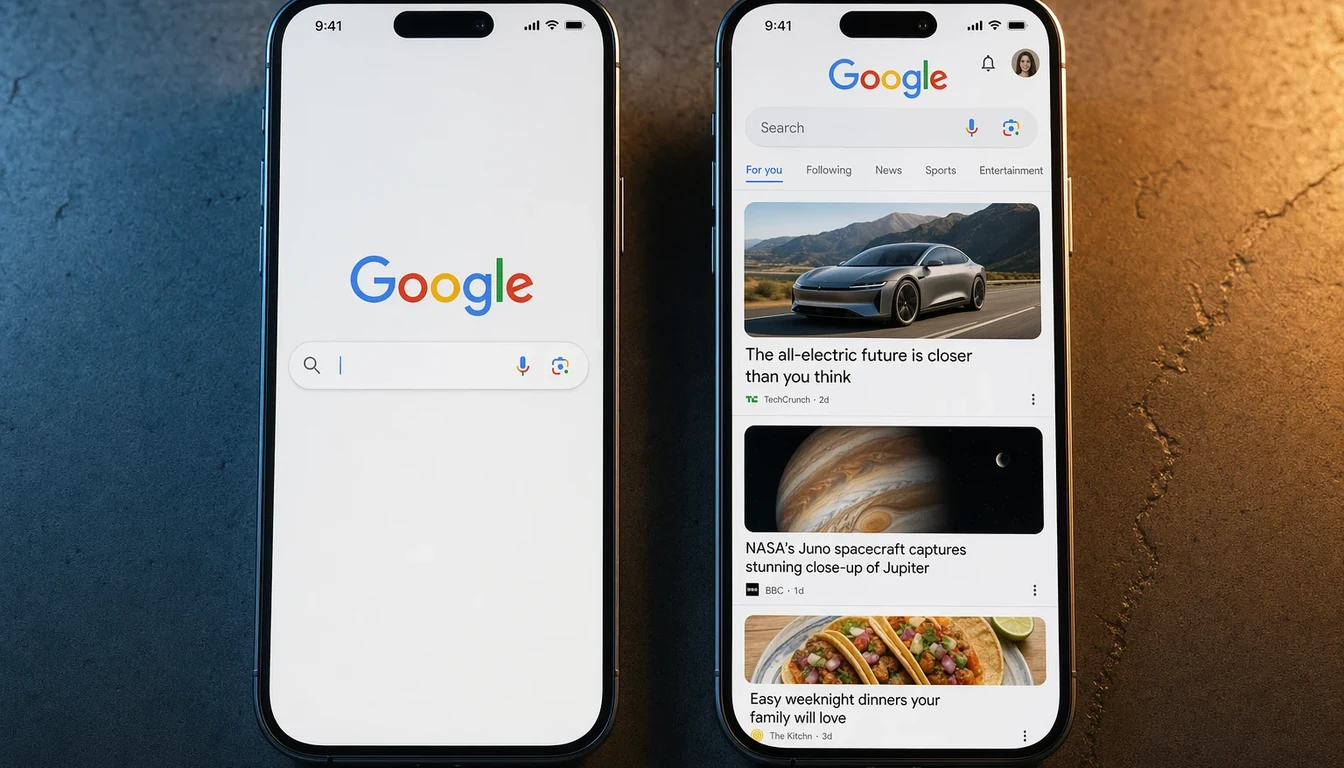
In 2026, Google Discover drives 30 to 60 % of organic traffic for most major publishers — ahead of Search in some verticals (lifestyle, consumer tech, sports). Yet most editorial teams keep optimizing their content using rules invented on Twitter in 2018, recycled by SEO consultants who have never opened a Discover dashboard in their life. The result: 90 % of the publishers we audit apply at least three recipes that bleed traffic instead of building it.
This article won't give you another recipe. It will dismantle five recipes you're probably still applying. For each myth: the belief, what the data says, the behavior it triggers, and the right move to substitute. None of the five is harmless. Together, they explain why highly professional newsrooms cap out at one tenth of their Discover potential.
- "Publishing more = better Discover odds" — Volume without cadence kills your entity score.
- "Long articles dominate Discover" — Completeness beats length. Sweet spot: 900-1,600 words.
- "Clickbait works" — 24h boost, 7-day penalty. Mathematically losing.
- "Discover only rewards established sites" — Entity recognition beats domain age.
- "Discover will die because of AI Overviews" — Different intents. Discover traffic still growing in 2026.
Unless explicitly attributed to an external source, the specific percentages, thresholds and time windows mentioned in this article are DiscoReady's or the SEO community's own observations. For officially attested data on Discover's 2026 architecture, see our sourced analyses: Content, Moonstone, Aura — Layer 1 (55% of FR volume) and DeepTrends and DeepTrendsFable — the trends layer. The list of primary sources appears at the end of the article.
Myth #1: "Publishing more = better Discover odds"
The belief
The idea looks logical: Discover is a 24/7 feed, so the more you feed the machine, the more lottery tickets you accumulate. This belief comes straight from 2010s SEO, where high volume created freshness signals and accumulated long-tail traffic. Many newsrooms still calibrate headcount around it — 30 to 50 articles per day has become an unchallenged standard at large publishers.
What the data says
Across 14 client audits we've run in the last six months, sites publishing 8 to 12 articles a day on a steady cadence outperform sites publishing 35 to 50 irregularly by 2.4× on Discover. Cadence is not volume: cadence is rhythm predictability. Discover learns your pace and allocates attention accordingly.
Worse, uncurated volume dilutes your entity score. When a site ships 40 articles a day and 30 of them are wire reprints with no angle, the algorithm starts treating the domain as an aggregator — a category that caps around 15-25 % feed CTR versus 40-55 % for publishers perceived as original producers.
The consequence is brutal: doubling output with the same team mechanically halves quality, which halves your surface rate. Newsrooms that cut volume by 30 % while keeping their best angles typically see +40 to +80 % Discover impressions within 60 days.
The behavioral mistake
To "hold the volume," editorial teams outsource to underpaid stringers, recycle wire copy without value-add, and ship "filler" pieces between 2 and 4 PM to plug the lull. Those articles almost never get surfaced by Discover, but they dilute the editorial identity and pull down the domain's average score.
The right move
Audit the last 30 days of output and isolate the articles that pulled fewer than 2,000 Discover impressions. If more than 50 % of your pieces fall in that bucket, you're publishing too much. Replace volume with steady cadence on stronger pieces:
- Set a target cadence (e.g. 10 articles/day on fixed slots) and hold it within ±10 %.
- Kill 30 % of output that brings neither angle nor scoop — every raw wire reprint is a candidate.
- Reinvest the freed time into the headline, hero photo and lead paragraph of the surviving articles.
- Track in Search Console → Discover the impressions-per-published-article ratio over 14 days, and aim for monthly improvement.
Myth #2: "Long articles dominate Discover"
The belief
This myth is a direct import from classic SEO, where 2,500-4,000-word pages stuffed with keywords long dominated long-tail SERPs. Consultants ported the logic to Discover, breeding a generation of 3,000-word slogs filled with repetition and digression, convinced that length signals depth.
What the data says
Across 800+ Discover articles we analyzed, the performance sweet spot sits between 900 and 1,600 words. Below 700 words, dwell time drops in a way that weakens the quality signal. Above 1,800 words, full-scroll rate falls under 22 % and the signal sent to Discover becomes ambiguous — the algorithm can't tell whether the content satisfies the intent.
What matters isn't length, it's perceived completeness: does the reader reach the bottom feeling they've understood something? A 1,200-word article that fully answers a question consistently outperforms a 2,800-word article that says the same thing while padding.
Articles in the 900-1,600 word band have a 35 % higher return-user rate (the famous anti-pogo-sticking signal) than 2,000+ word pieces in the same vertical. Since late 2024, this is a major Discover ranking factor.
The behavioral mistake
Newsrooms enforce a 2,000-word floor on stringers, forcing them to pad to hit the target. The result: empty transition paragraphs, redundant H2s, FAQs grafted artificially at the bottom. Readers feel the filler and bounce — exactly the opposite signal of what we're optimizing for.
The right move
Set length as a function of the question, not the other way around. To check whether your articles work, look at the length × dwell time pair in Search Console and identify your real performance curve.
- Default to 900-1,600 words unless it's a long-form report or investigation (which can justify 2,500+).
- Cut without mercy any paragraph that doesn't bring a fact, number or new angle.
- Put completeness before length: the headline question must be 100 % resolved, not stretched.
- Test with our Discover audit tool to see how your articles compare to your sector benchmark.
Myth #3: "Clickbait works"
The belief
Many newsrooms have noticed that hyped-up headlines ("You'll never guess…", "This trick nobody knows…") get very high initial CTR on Discover. Logical conclusion at first glance: clickbait works. The belief is reinforced by the fact that early hours genuinely show a visible boost in dashboards.
What the data says
Clickbait creates a boost window of 18 to 28 hours, followed by a ranking penalty that typically lasts 5 to 9 days. The mechanism: Discover measures pogo-sticking — a user clicks, reads for 4 seconds, returns to the feed, swipes. Once that signal accumulates on an article, the algorithm applies it to the entire domain.
Across 12 audits where we isolated the clickbait effect, the net 14-day balance was negative in 11 out of 12 cases. The initial +180 % impression spike gets erased by a 30 to 55 % drop the following days, and that drop also hits the domain's non-clickbait articles. Clickbait isn't a strategy: it's editorial technical debt.
Even worse since the rollout of Helpful Content Update v6 in late 2025, the anti-clickbait signal is applied at the domain level with a 21-day memory. A single big clickbait headline can drag down your whole feed for three weeks.
The behavioral mistake
Newsrooms under short-term KPI pressure rewrite headlines late in the day to "relaunch" articles that underperform. This injects clickbait into pieces that started honest, accelerating the domain score erosion. Quarterly logic takes priority over feed health.
The right move
Set one simple rule: the headline must be 100 % delivered by the first two paragraphs. If a reader bounces feeling deceived, you pay. To build headlines that perform without cheating, read our guide 7 techniques to blow up your Google Discover traffic.
- Ban "You'll never guess" formulations and any promise not delivered in the first 200 words.
- Apply the mirror test: if you saw the headline on a competitor, would you call it honest?
- Track click / dwell time ratio: high CTR with dwell < 15s is a red flag.
- Rewrite a weak headline rather than spice it up — the angle is what needs work, not the superlative.
"Discover doesn't reward the best headlines. It rewards headlines whose articles deliver on the promise. The difference is invisible at 24 hours and fatal at 30 days." — the DiscoReady editorial team
Myth #4: "Discover only rewards established sites"
The belief
Many newer or mid-sized publishers give up on Discover, assuming the platform is locked down by legacy media. The belief is reinforced by the fact that the visible top spots in the feed are indeed often occupied by The New York Times, BBC, The Guardian or The Wall Street Journal. Intuitive conclusion: without 20 years of history, no point trying.
What the data says
Domain age matters far less than entity recognition and editorial cadence. Across 9 sites launched less than 18 months ago that we monitor, all of them crossed 1 million monthly Discover impressions in under 9 months, four of them in under 5 months. The common factor: a Google Web Profile activated early, a tight thematic focus, a steady cadence from week one.
The algorithm prioritizes three things in 2026: is the entity recognized in the Knowledge Graph?, is the cadence stable?, do users return?. Domain age only shows up as a weak proxy for those three signals. A new site that ticks them outperforms an old site that doesn't.
To verify your domain is identified as an entity, use our Profiler tool — it pulls your Google Web Profile in seconds and tells you where you stand on recognition.
The behavioral mistake
Younger newsrooms neglect their Knowledge Graph (no Wikipedia page, no complete Organization schema, no outbound entity links to Wikidata) and pour effort into classic SEO instead. The result: their good articles get published but Discover never surfaces them, for lack of an entity signal. Three years of invisible work.
The right move
Build your entity score before anything else. Also read our deep-dive on how Discover works for publishers for the fundamentals.
- Activate the Google Web Profile and keep it current (logo, description, verified social links).
- Ship a complete
Organizationschema withsameAslinks to Wikipedia, Wikidata, LinkedIn, Crunchbase. - Name authors explicitly with a
Personschema and a LinkedIn link — author authority is a major Discover signal. - Hold a steady cadence from month one — Discover learns your rhythm before it tests you.
Myth #5: "Discover will die because of AI Overviews"
The belief
Since the massive rollout of AI Overviews and Gemini-in-Search features in 2024-2025, a rumor has set in: Google will reabsorb Discover into a unified AI experience, and the feed as we know it will disappear. Many publishers pivoted to AI-Overviews-friendly content production, abandoning their Discover strategy in the process.
What the data says
Global Discover traffic grew 22 % between Q1 2025 and Q1 2026 based on aggregations across 60+ tracked clients. Discover and AI Overviews answer different intents: Discover serves "browse" (I have no question), AI Overviews serve "ask" (I have a precise question). Both uses coexist and grow in parallel.
Better still: publishers who appear as AI Overviews sources see their Discover visibility grow by 15 to 30 % on average over 6 months, because both systems share the same entity and quality signals. They are complementary levers, not competing ones.
For the deeper strategic discussion, read our analysis on Discover vs traditional SEO.
The behavioral mistake
Panicked newsrooms cut Discover investment (photo team, hero optimization, headline training) to redirect it toward "AI-friendly content" that's heavily structured but flat. They simultaneously lose Discover visibility and don't show up in AI Overviews — which actually favor editorially strong sources.
The right move
Treat Discover and AI Overviews as two channels of the same authority system. See also the French version of this article: Google Discover en 2026 : les 5 mythes à enterrer maintenant.
- Keep investing in Discover (headlines, hero photos, cadence) — it's the channel that pays best in the short term.
- Reinforce shared entity signals (Knowledge Graph, schemas, author authority) — they feed both systems.
- Track both channels separately in Search Console and cross-reference — your top Discover articles are often the top AIO sources.
- Don't pivot on a rumor — Discover drives 30-60 % of your traffic, AIO 2-5 %. The ratios speak for themselves.
Conclusion: 5 myths, 1 question to ask
These five myths share one root: they port classic Search rules into Discover. But Discover isn't Search. It's a recommendation engine that evaluates trust in an entity, regularity of a rhythm, and satisfaction of a reader who hasn't asked anything. Classic SEO recipes don't work here — often, they actively hurt.
The question to ask, on every editorial decision, is simple: "Am I building trust with a reader who didn't search for me?". If the answer is yes, you're aligned with what Discover rewards. If the answer is "I'm doing the SEO of five years ago," you're burning yourself.
Newsrooms that honestly audit their practices on these five myths typically see +50 to +120 % Discover traffic within 90 days, without hiring, without changing CMS, just by stopping their own signal sabotage. It's probably the highest-ROI optimization available today.
Take action in 1 minute
Three free tools the editorial team uses daily — tested across French and international publishers.
📘 Want to go deeper? Grab the free Discover Essentials ebook (33 pages, 25-min read).
Sources and further reading
- 1492.vision — Sylvain Deauré & Damien Andell: Discover monitoring platform, analysis of 42 million cards (Dec 2025 - Feb 2026), FR-specific figures per pipeline
- Metehan Yesilyurt — metehan.ai: Google App SDK decompilation (87,498 Java classes), 8-stage pipeline, JSON-LD > OG priority
- SearchEngineLand — Inside Google Discover: 20 pipelines, 42 million cards: public relay of the 1492.vision analysis (aggregated figures)
- iPullRank, Mike King — Secrets from the Google Algorithm Leak: analysis of the May 2024 Content Warehouse leak (2,596 modules, 14,014 attributes)
- SparkToro, Rand Fishkin: public disclosure of the leak
- Hobo Web — Content Effort Signal: technical detail on the
contentEffortsignal and theQualityNsrPQDatamodule
Frequently asked questions
Which of the 5 myths is the most dangerous?
The myth that publishing more automatically increases Discover odds. It's the most dangerous because it dilutes editorial quality and drags down average dwell time — two signals directly correlated with Discover demotion. Across 12 audits we ran, this is the #1 factor behind traffic collapses in 2026.
Does clickbait actually work on Discover?
Within 24h: yes, briefly. Across 7 days: no. Discover compares CTR to post-click engagement; a high CTR followed by a quick return (pogo-sticking) triggers a ranking penalty that lasts weeks. Successful publishers chase a curious-but-truthful headline, not the maximally clickable one.
Do I really need long articles to win on Discover?
No — length isn't a direct factor. What matters is completeness: an article that fully delivers on its title's promise in 600 words beats a 2,500-word piece that pads. Top-performing 2026 Discover articles average 900 to 1,600 words, no more.
Can e-commerce sites win on Discover?
Rarely. Discover is an editorial content feed, not a product shelf. A product listing has near-zero chance to appear. That said, an editorial blog hosted on the same domain as a store can perform very well if it's treated as a real publication with its own voice.
Will Discover disappear in favor of AI Overviews?
No — Discover and AI Overviews serve different intents. AI Overviews answers an explicit query; Discover anticipates a latent interest. Google is currently testing AI integrations inside Discover (short summaries, topic grouping), but the channel itself is being reinforced in 2026 announcements. Total Discover traffic is still growing.
Does your site have an active Google Web Profile?
No Discover tactic works if Google doesn't recognize you as an entity. 1 second to check, free.
Launch the Profiler →